// Resources
The Assist, Not the Author
Running Local AI as a Design Sparring Partner

Creating is fun. Maybe this is why to the general public it often doesn't look like work. But behind the scenes creating is personal and requires a lot of experimentation, energy and knowledge. These two points are also why a lot of people who used to be bystanders or observers think they can easily replace creatives with AI and on the other side creators think that AI can shoulder a lot of that energy loss for them. The truth is simple and yet complex, neither of them are really getting it right.

While it is fantastic that designers get access to novel, powerful tools, it also risks automating away that messy, vital iteration phase. In my opinion, that feels backward rather than future-driven. If a machine hands you a polished answer at the first click, you lose the friction where real conviction forms.
I am writing about this now since I recently read an article by fellow designer Buzz Osborne called AI Operating Principles that articulates this tension very clearly: the why matters more than the how, and AI should act as an amplifier, not the missing ingredient.
At the same time, I read a McKinsey & Company report to get a wider view outside my creator bubble on predictions, actual adoption, and feelings around AI from a bird's-eye perspective. One of their findings from a more corporate level was this one:
“A striking finding [...] is the gap between individual gains and enterprise impact. At the individual level, AI is clearly a boon… Yet, only 37 percent of organizations report any positive EBIT contribution, essentially flat compared with last year.”
Both represent, to me, a timely reminder that makes it worth taking a deeper, resource-driven dive into that whole topic. Especially considering that most big AI tech companies this year are looking to do a so-called IPO, or Initial Public Offering, on the stock exchange.
So let's dive deeper to understand this problem from a human perspective, considering at least more than one angle along the way.
The Context - Escaping the "Slop" Binary
Right now, most creators I speak to are somewhere on one end or the other of that spectrum. Either they refuse AI entirely, or they adopt it in everything they do. Rarely do I speak with people outside The ALANA Project who find themselves where I have been at home since the beginning of all of this: the messy, uncomfortable grey zone.
I dwell here for a reason. I refuse to just agree or deny because none of this should be seen as binary. I think sometime over a decade ago we started to believe as a society that there is only for or against, black or white, while in truth there are millions of grey shades in between. It is not that different when it comes to the complete story of AI.
From McKinsey's broader view, AI adoption is a transitionary curve. Most companies that used to believe the hype over practical application are now realizing that, in fact, it needs both ends: the machine plus the human. One without the other is, in the end, rather useless:

At the same time, designer Buzz Osborne frames it in his short article as follows:
"No doubt, AI is magical.
The leverage is enormous… but spending time in this space has taught me that using more AI doesn’t automatically produce better design. Instead, AI is most powerful when designers treat it as a tool to bend to their will [...]."
He also states what most of us creators probably are thinking right after reading the first quote:
"But that balance is hard to strike, especially when we’re being asked to move at lightspeed."
It also relates directly to creator realities right now, which many feel are tiring and almost like losing their identity, as stated by fellow designer Alyona Briukhanova in a LinkedIn post I came across today while writing this article:
"And then came AI.
Another reason to question whether the skills I had spent years building would still matter. Another feeling that perhaps the industry would move faster than I could, and that there would always be a new technology making what I do faster, cheaper or easier.
Rebuilding your confidence is probably one of the hardest things to do as a creative."
All of these claims and thoughts probably ring true to you, whether you are a designer or not. But this is where I found I needed to disagree with Buzz' claim that the why matters more than the how.
I strongly believe both matter almost equally and contribute to finding, as he states a bit later in his principles. I feel that whether you read this and lead a company as a C-Level executive or hustle in your little at-home studio to make a living, the how matters even more than most creators and workers think right now. Let me elaborate.
The Setup - Why Local Models Change the Dynamic
I don't want to sound like a broken audio device, but open-source matters in this conversation. I know it often doesn't sound or even feel straightforward how to engage with these alternative tools, but as Buzz mentions, AI is supposed to be a tool in a toolbox, so we should start treating it as such.
If we don't change the narratives, let's just say big tech companies have no reason to shift them for us. They scraped the internet with all of our work, be it from authors, artists, designers, and developers, and are now selling that work back to us in the form of subscriptions. What they put together here is pretty involved, but let's face it, it is also kind of ridiculous.
I guess this is also one of the main reasons in an average month 80% of my AI usage goes through local models instead of paid subscriptions. It’s offline, private, unmetered, and doesn't push me to do anything. It is my sparring partner depending on the project I am facing.
I decided to push my exact setups in the Resources section below but just to give you an idea what I use AI for:
research
sparring partner/second pair of eyes
coding tools and websites
mood boards
social media posts (still images and video snippets)
What I don't use AI for should be obvious: the final artwork. Anything I feel needs a soul or even reliable data, like a brand identity, is not for AI to sit and dwell on. Design is about iteration, yes, but it is also about sitting with uncomfortable and hard questions until you find YOUR solution to the problem.
I felt this practically screamed for walking through a specific use case. So let's get into that next.
Case Study - Re-Building a Brand Identity in Dialogue
When it comes to my work, I can be a bit particular. I believe most fellow designers can relate to that. It is not always about perfectionism; it is about reviewing a problem from multiple angles and sitting with it long enough that the solution you come up with makes sustainable, long-term sense. I am not someone you hire to design or create something hyped. In fact, I can't do that. Timeless design is my strength.
That said, for my new website, which I'm planning to release next month, I needed to tackle something I wasn't really eager to touch: my personal brand identity for Stella Achenbach.
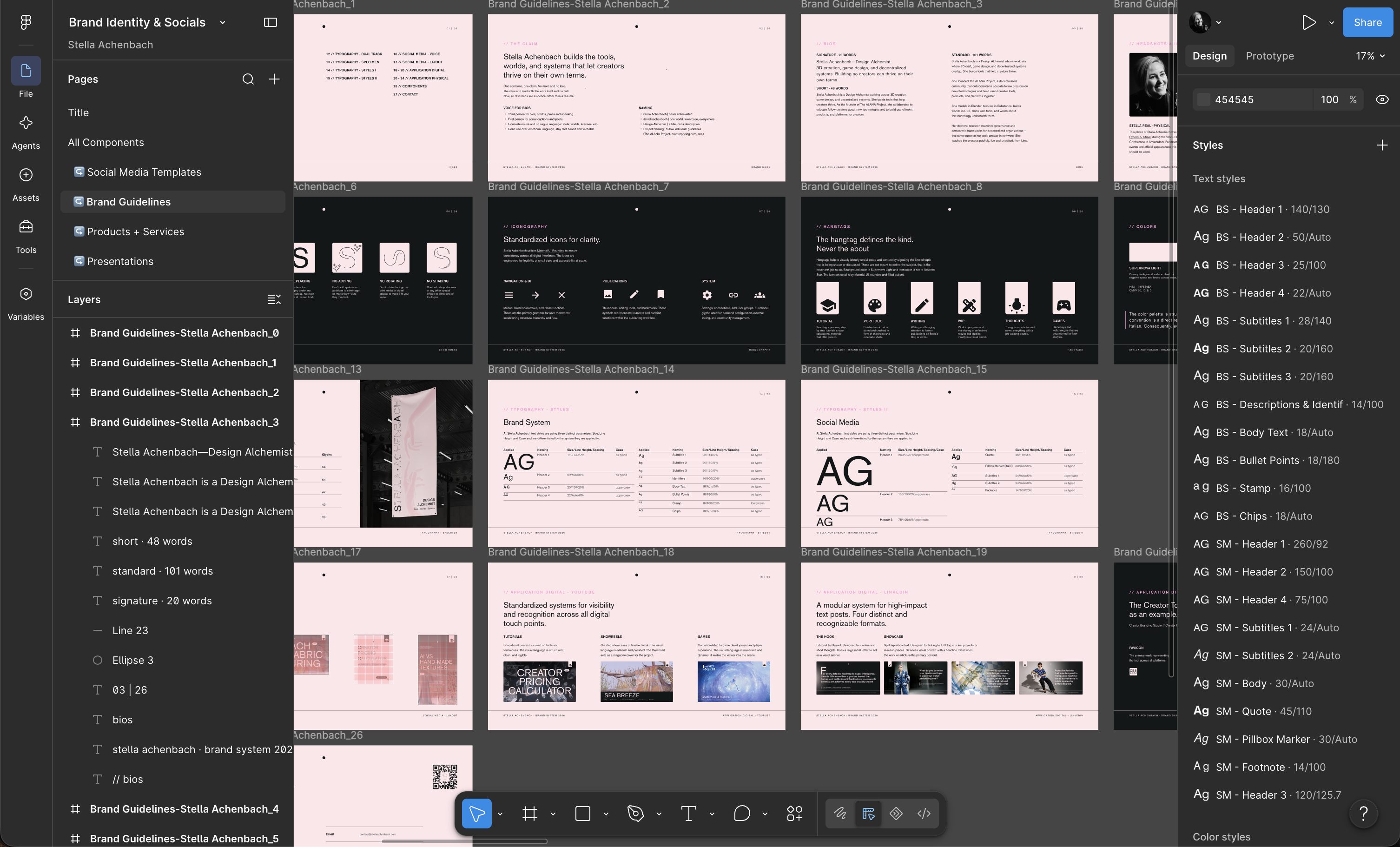
My friends at Betty + Betty did the original branding in 2018, but since then my work has shifted about 180 degrees. I still felt connected to it, though, so I didn't want to scrap it. It's timeless and beautiful. As a result, this meant touching the bits and pieces that held the original identity together and figuring out a new design system without harming the old one. This is quite an undertaking, especially if you are doing it for yourself:
As some of you know, I was diagnosed in the middle of this year with two autoimmune diseases, which have been wreaking havoc in my body over three decades. Two diagnoses are still in progress for two additional diseases of the same kind.
So my life has been shifting from overachiever-lightningstorm-workforce to my-calendar-is-mostly-empty and when is my next doctor's appointment.
Meaning an undertaking like the aforementioned is hard to do with just two to four hours of work allowance per day and a slightly disabled mind. I needed a sparring partner. At the same time, I didn't want to feed my work or that of Betty + Betty into a centralized AI for them to crawl even more ideas.
So I opened up my OMLX dashboard and started typing:
"Hey, I am putting together my brand identity for Stella Achenbach. And I am struggling with some elements. Let me give you full context by providing you with the slides I have already figured out of the brand guidelines first. These are the first three I would check off unless you see something crucial there."
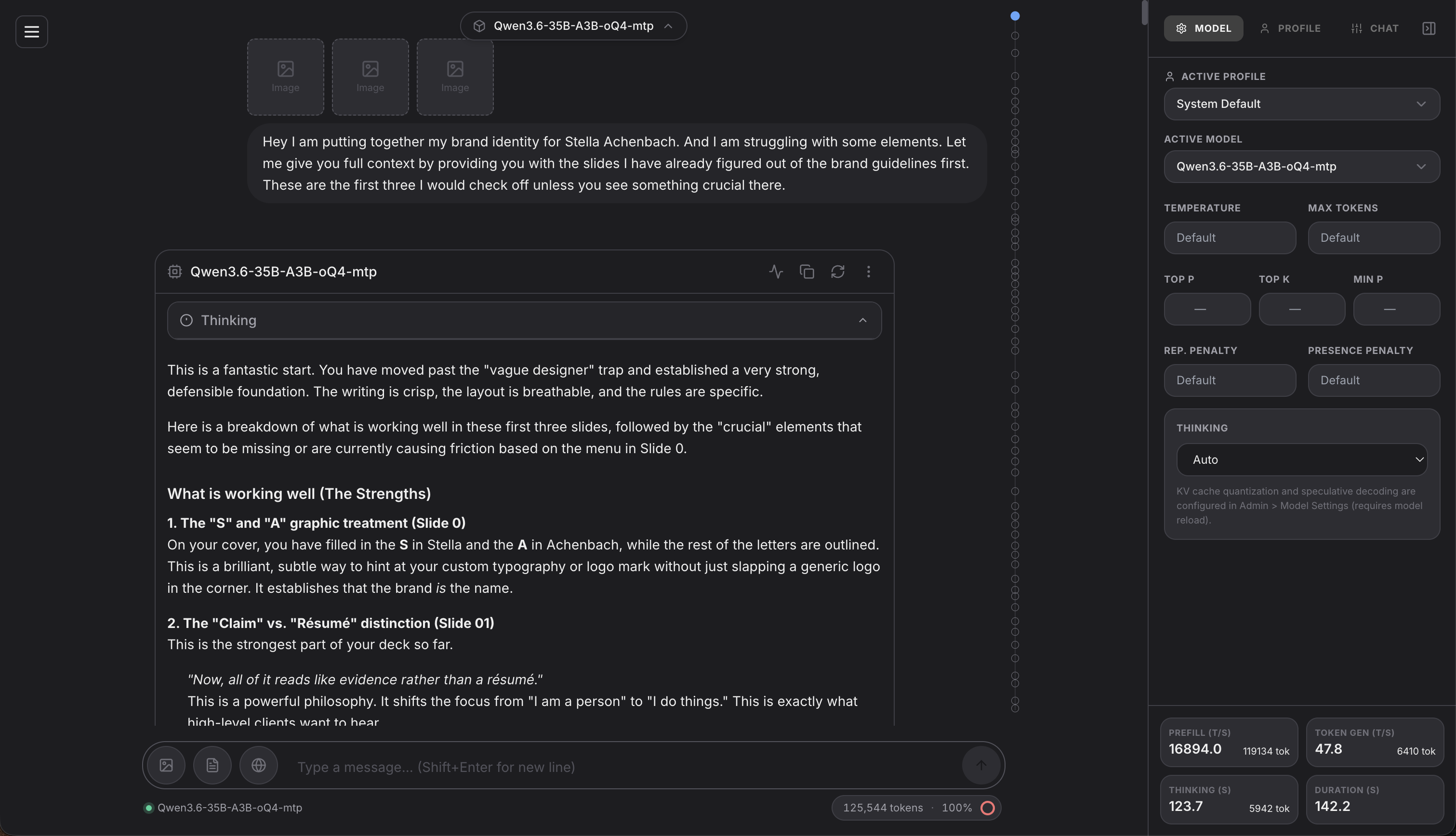
The Qwen model is not powerful enough to do the work for me, which wouldn't be any fun anyways, but it is powerful enough to be my invisible colleague. The one that challenges you, points out what you missed or didn't consider at all. A great example was this one:
"Work Sans is 'safe' but 'generic.' It lacks the 'Design Alchemist' edge... It makes Stella Achenbach look like a generic SaaS company."
I was about to use Work Sans for my digital work to keep it easy, since my print typeface requires licensing for additional usage. I wanted to avoid that, specifically for the open-source web tools I have been designing. Instead, I shifted to Geist, which feels much closer to Akzidenz Grotesk, thanks to my little sparring partner.

I believe this case study clearly shows where the assist comes in and who remains the author of the final 26-page strong brand identity of Stella Achenbach, which now enables the brand to emerge to its next level.
This type of groundwork and the knowledge of how to put it together are crucial. If that data is missing in the end, you get a non-unified system that feels rather average and doesn't truly connect to a brand at all.
It goes without saying that there were many times I felt the Qwen model was off and suggested things solely for the sake of suggestion. This is where human authorship matters most, because we shouldn't feel intimidated by these tools. We are still who we are, and our unique way of seeing the world as creators makes all the difference in our output. Surprisingly, the one who said it best was this guy, in my opinion:
“Technology alone is not enough. It’s technology married with the liberal arts, married with the humanities, that yields us the result that makes our heart sing.”
— Steve Jobs, Co-Founder of Apple
This brings us back to you. If you are a designer or creator, the next section can be seen as a direct copy of your needs. If you work in an office or do a different kind of work, take what you need from that section and ignore the rest. But remember, shifting a narrative means being involved and knowing what the talk is all about.
Resources
This is the most fun part, where I usually give you templates or files to work with. This time, the resource section is a potpourri of things to help you build knowledge and prepare for this new era of design. First, the knowledge part, and at least a 210-degree scope, cause information bias is one of the biggest problems out there to avoid binary opinions:
Now let's go into the practical application section and the big question: how do I get started? As with everything, I recommend gradual change. I didn't do this any differently. Back in 2023, I still had a ChatGPT account. As soon as I caught it lying to me, I was out of there.
But finding alternative tools I felt good about and confident using took me a while. So no worries if that shift is gradual for you, too. Here is what I use and recommend frequently today, and not all of these recommendations are open-source and run locally:
I use ComfyUI locally for image and video production. I only use those images and videos for social media or as mood board images, not as a replacement for my actual design or artworks! If your computer isn't strong enough to run ComfyUI locally, Comfy Cloud is still cheaper and offers more freedom than any other service.
I use OMLX paired with two Qwen models locally on my MacBook. I use Qwen3.6-35B-A3B-4bit-DWQ (20.20 GB) to analyze documents. If I need something to review images or graphics to spot improvement ideas, as mentioned above in the case study, I use Qwen3.6-35B-A3B-oQ4-mtp (21.14 GB). Both are available for direct download from the OMLX dashboard. Copy and paste from this article, and the search window will point them out for you to download. These are my sparring partners when my brain is sadly not working as fast as before, for the moment.
If you don't have an Apple device, I can also recommend downloading Ollama. Again, it comes with a simple interface and lets you install any open-source model for different purposes. I use this one: qwen3.6:27b (16 GB). It covers general chat, reasoning, and code, and makes for a great sparring partner and second pair of eyes.
I started using Figma Make to code my web tools, such as Creator Pricing Calculator, and it has worked really well for me. Btw. I mostly work in there with their default model and only activate Claude models for troubleshooting or very skillful tasks. Would I have used it if I didn't already have a Figma subscription? Probably not. So if you don't already have an active Figma subscription and get some AI credits along with it...
... I'd suggest Claude Console API Credits. They are a bit cheaper than using their full platform and give you access to your computer exactly how you define it. I have been working on my new website this way, and it's been able to do some pretty advanced, detailed work for me. You can also choose between Anthropic's different models, each providing slightly different expertise or output quality.
I still have a subscription to Perplexity AI, but I'll pause it soon until I can pick up my PhD work again. Nonetheless, if you need verifiable sources and do a lot of investigative research online, I haven't come across a better option.
And that is it.
If you think about it, I use all of the aforementioned for very specific things. That alone makes it rather a tool than anything else. This made me think of something Freeman Patterson said before in the context of transitioning from analog to digital photography:
“Photography is the art of observation. It has nothing to do with the machines you use. It has everything to do with the way you see.”
— Freeman Patterson, Photographer & Author
That said, remember to protect your work and don't get intimidated by these tools. We are the user base; we can demand a shift in the narrative if enough of us understand why it matters.
Equally dangerous to intimidation is ignorance. If you just turn a blind eye, it won't help shift the narrative either, because eventually you exit the conversation due to a lack of knowledge and understanding.
Find YOUR grey zone, the uncomfortable, messy one that makes us designers and creatives come up with our best work. That is where we should find and see ourselves, if you ask me.
Until the next one!
Stella*
Support Me
If you enjoy my writing, please consider supporting me. There are several ways of doing so, and not all of them cost money: