// Journaling
My Open Source Story
Why open source technology matters more than most of us think

When I was about 11, I started helping out in the IT (information technology) department my dad led at a steel pipe-producing company in Germany. I was introduced to computer technology quite early in my life, and the term open source software was somewhat familiar to me.
But only a few years ago, I truly understood its power for all of us.
In the past two weeks, something really important happened that shifted the fundamentals of the creative industries and beyond. You might have missed it, but ArtCraft happened.
ArtCraft's founder reprogrammed the entire Microsoft Office and Adobe Suites in another programming language, with the help of Artificial Intelligence (AI), and gave it to everyone for FREE! It is open source.

Some of you might know what open source technology is; some of your may not. This article is for all of you. It covers what open source technology means and introduces a tool I built, called Material Creator, which I'm giving to creators for FREE as well :).
What "Open Source" Actually Means
Open source relates to the publishing of digital resources, such as software, with their source code publicly available, allowing anyone to insprect, modify, study and redistribute the work.

To be officially classified as open source software, it must meet the Open Source Definition established by the Open Source Initiative (OSI), which sets out ten specific criteria. Most important are the following:
Free redistribution: No royalties or fees for distribution.
Source code access: The uncompiled code must be available or easily obtainable, for example via GitHub.
Derivative works: Modifications and derived works must be allowed under the same license terms.
Non-discrimination: No restrictions on persons, groups, or fields of endeavor (including commercial use).
Long before Eric S. Raymond, Bruce Perens, and others founded the OSI and later used the term open source to promote their commercially friendly label, Christine Peterson coined it in 1998. She used the word during a strategy session that was about publishing Netscape's source code publicly.
The truth is, a lot of normal things we do on a daily basis are supported by open source technology or open standards. Open standards are a slightly different concept, but most internet protocols that allow us to go online are based on them. They make internet access license-free and ensure theoretical open access (theoretical because it still requires a hardline and devices to go online).
A fantastic, very direct open source example registered on ~4 billion devices globally is the mobile operating system Android. In fact, it's the most-used operating system in the world, and its core (Android Open Source Project (AOSP)) is genuinely open source. Google keeps publishing the full source code twice per year.
It is such a great analogy because most people just pick up their phone, not knowing that it is open source that makes it run. This open model is part of the reason why Android is one of the most widely adopted mobile operating systems. It also allowed Samsung and other companies to build on the same standard and make access to everything mobile less exclusive. A single company with a proprietary system could not have replicated that type of success. Just like the internet's open standards, Android is maintained by a much wider community than just Google.
One of the biggest misconceptions I have come across in the past five years about open source is that many people think it is about "coding for everyone" or that you can't make money with it. Both are untrue:
The Pushback Era
Independent creators may feel something more than most: "subscription fatigue." If you work in an office and have a 9-5 job, you might not notice, but every piece of software you use at work or on your company-sponsored laptop needs a license. Those licenses cost a lot of money, but the larger the company, the less that amount matters.
This is, of course, very different for independent creators. While office workers use an average of five different digital programs, creators use about double or triple that. Yet, they lack the stable income to make those amounts matter less.
Just to give you an idea from my own yearly subscription pool:
Microsoft 365 Personal (1 User/Excel, Word, etc.) 365 = $99.99
Adobe Creative Suite (Photoshop, Premiere Pro, etc.) = $839.88
Adobe 3D Suite (Substance Designer, Painter, etc.) = $599.88
Marvelous Designer (3D Clothing Designer) = $280.00
Figma (Collab Design 1 Pro Seat) = $192.00
Milanote (Collab Board) = $99.00
-----------------
= $2,110.75
This might not seem like a lot if you have a fixed income or have been a designer/creator working in North America or Europe, but these prices sadly apply to a global creator community. That means the balance between achievable income and cost can easily get out of balance.
That said, even as a junior designer, I often struggled to make $2000/month, so cutting that cost can feel unreasonable no matter where you work or where you're from.
There are bigger picture problems, though, than just individual cost:
These days, tools have to be rented, which means creators no longer own them. As a result, file access is only granted to those who accept so-called "vendor lock-in." For a creator, the real value lives in their files, so losing access is unthinkable.
In the last decade, Adobe Cloud subscriptions have risen by 40%. That alone is a steep increase, while daily living costs have risen by 26% globally, with food among the biggest increases. Yet earnings have been reported as stagnant at best. Even Adobe's own creative industry report states that while top earners' income has increased, average creatives have lost purchasing power.
Perhaps the most outrageous problem occurred in 2024 when Adobe held users at gunpoint to accept new terms & conditions in the context of training their own AI model, Firefly. The new terms were vague and led people to believe Adobe was using creators' data and assets to train its own model.
The upsetting part of all three points above is one and the same: It is unfair. Creatives pay, yet have to freely give. This one-sided relationship has been endorsed and normalized over the past decade, and frustration levels have risen.
With the emergence of the third generation of the internet (Web3, blockchain, AI, etc.), users, and especially creatives, have decided to "fire" back. I call it the "Pushback Era."
The Spark
In the end, frustration can be a fantastic motivator, as ArtCraft proves. No matter what happens with the project long term, it gave creators and beyond hope and inspiration. Right after the tools came out, I joined the ArtCraft Discord. In less than two weeks, it grew to six times its original member size.
Some chats confirmed the frustration that fueled it all. Others clarified that creators who had opposed using AI in gen "artworks" supported applying it to the tooling suite. But most of all, the Discord chats confirmed that open source is no longer a nice-to-have; it puts power back in people's hands. It's a mirror showing how dependent we have become on centralized tools and the imbalance they create.
So I took that inspiration and newfound motivation and decided to build my own open source tool for creating procedural textures that can be applied to 3D models. I call it Material Creator.
Seeding the Spark
As some of you know, I am no stranger to advanced AI use, especially vibe-coding (coding with AI assistance), but building a software tool is still on a whole different level.
So far, the closest I have come to building tools has been web-based applications (CreatorPricing, CreatorBrandingStudio, CreatorContractBuilder, Adoptame, and similar). They follow very different standards and requirements than building software.
There is a reason that building software tools takes years, vs. websites used to take months. The difference is labor intensity, the resources required, and the knowledge needed.
When it came to building Material Creator, I knew exactly what I wanted, or didn't want:
Avoid the legal grey zone around Adobe's procedural texturing tool, Substance Designer.
Make it stand on its own, which meant it needed unique selling propositions for users.
Quality and usability need to be in sync. It needed to be easy to use, with a non-overwhelming user interface, while still delivering high-quality output.
Make it as accessible as possible, hence making the code open source and publicly available.
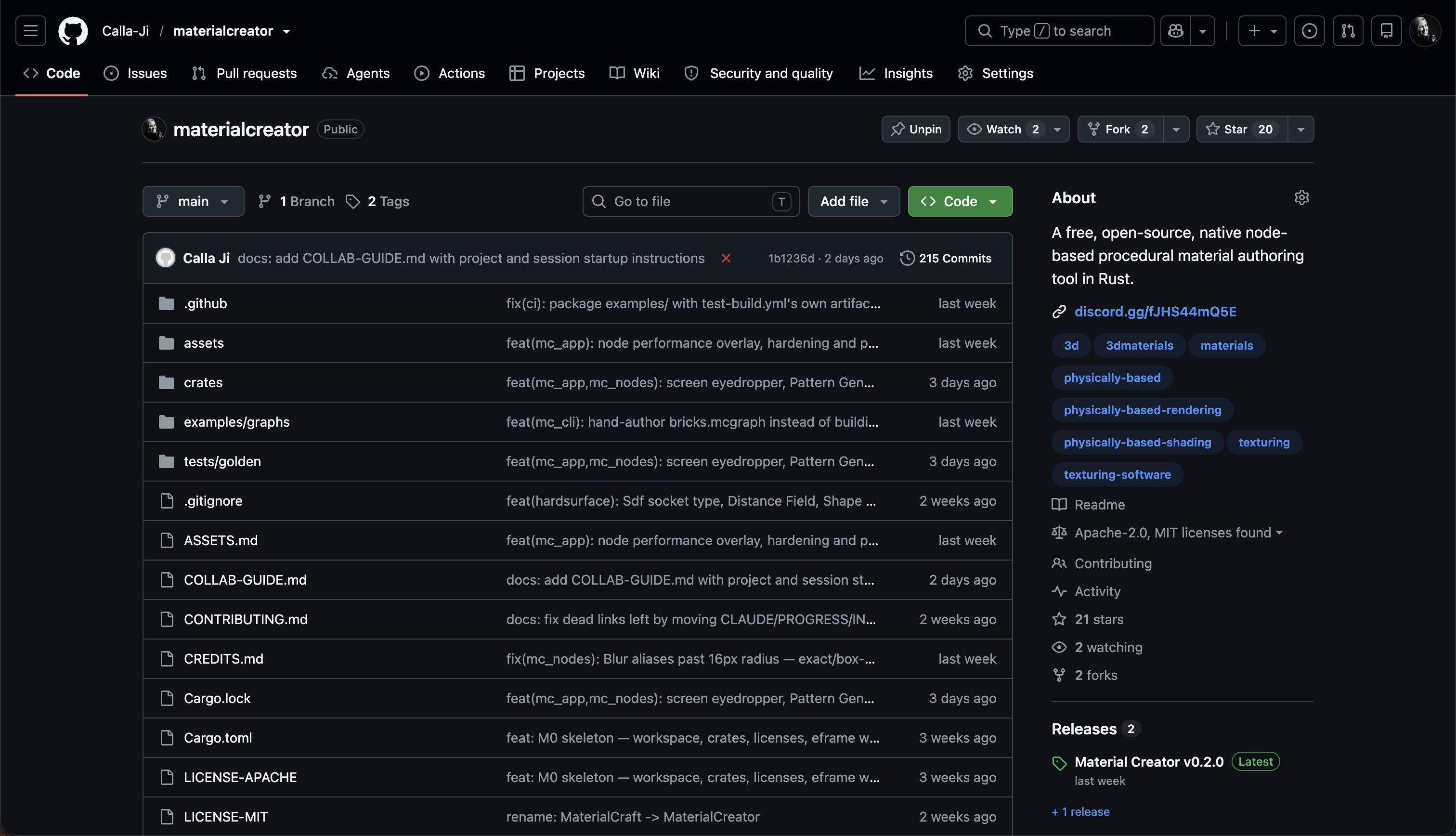
There are already other procedural texturing tools out there; some are even open source. I believe I tried them all at this point, and they either do not come close to the quality or come with vendor lock-in.
That said, you can download Material Creator today from my public GitHub repo, and it's free to use under the Apache 2.0 and MIT licenses. It's available for Linux, Windows, and iOS.
Before you ask, the current version, as of writing this article, is still under development. I believe that to get a truly fantastic product, I still need to triple the time and energy I have already put into it.
What's The Point
At this point, many might ask: "Why are you not selling this?" or "Why make it free, if you invested time, money, and energy?" or simply "What is the point?"
The point is simple: make advanced tooling accessible! That's my most singular reasoning, followed by: If someone paid for a tool, they should own that version!
Also, I will sell it ;). As discussed above, open source can sometimes feel misleading; just because it is free doesn't mean you cannot sell it. On GitHub, I currently publish the pre-release versions to test, apply feedback, fix little bugs, and add more features.
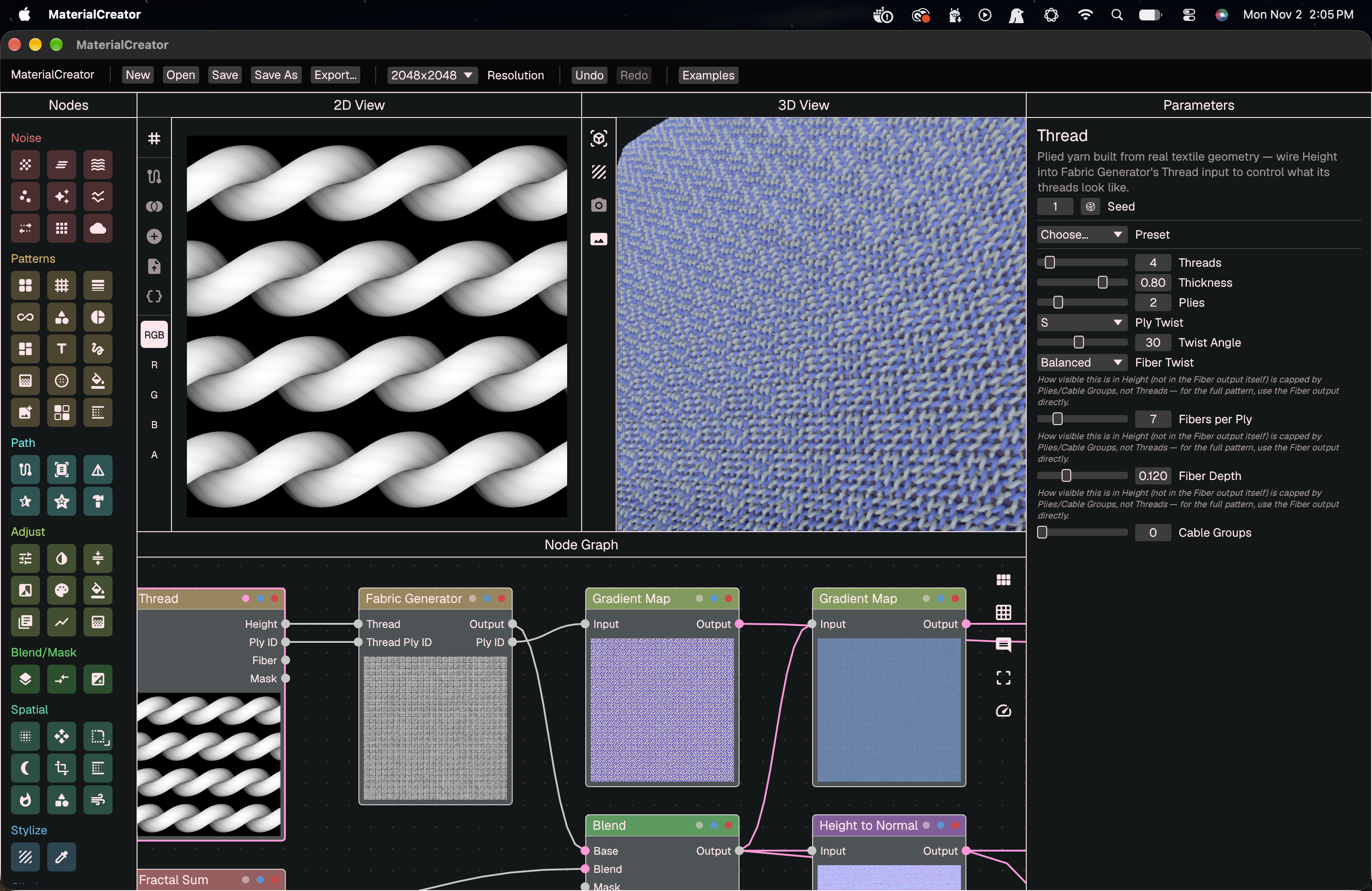
Once this phase is done in a few months, I plan to make Material Creator available in neat little installers via my website. At that point, it will be a convenient way to download and install the tool, which most users can't do now.
If you want to learn more about Material Creator and how to use it, don't fret; my next article will cover that and show off some unique "nodes" this tool ships with. Stay tuned, and in the meantime, feel free to download and run the pre-versions, open bug reports and issues on my GitHub repo, and let's make this tool as wonderful as possible so it becomes a great resource for the creative industries.
The Quiet Revolution
If you're not working in the creative industries, this article may helped explain why many creators and builders depend on open source tools and programs for cost, privacy, creativity, and sovereignty. If you work for a bigger institution or organization, the OSI survey 2026 might be a great inspiration to learn how open source technology can fit into your company.
For those of you who are creators, use your creativity and your boundless imagination to let this put your skills on steroids. With what you can already do and what you have observed in your part of the planet, how can YOU use AI to make the world better a little piece at a time? It doesn't have to be a full software platform; you could run a virtual pet adoption center as I do with adoptame.pe, or develop something unique to your community that solves a problem they face.

I think now more than ever it is important to start imagining the world as we want to see it, and not leave it to the few who already own most of the world's viable resources. They have long forgotten about us, don't see us as equals, and don't listen to our opinions. We are more, yet they get to decide. Using their tools to make the world in our image and make it better for many people, I believe that is what applied creativity should look like today.
Support Me
If you enjoy my writing, please consider supporting me. There are several ways of doing so, and not all of them cost money: