// Gaming
The Tomb Raider I Experiment - Part 1
The Idea & The Dig

When I think back to my childhood, a few instances stand out. One of them was building a PC tower from scratch together with my dad after literally burning through my old Atari. You'd think I meant "burning" as a manner of speech, but literally, it went up in smoke after overplaying a racing game whose name I can't recall.
One of the components of that new tower was a 3dfx Voodoo card, and it came with a game called Tomb Raider I. At the time, the only games I truly enjoyed while everyone was playing console games were Windows-based racing games. You can probably imagine me reading that this game was something entirely different; I wasn't even interested at first.

But during a long and boring weekend, I unpacked the game and figured, why not try something new? The back of the CD-ROM promised to meet Lara Croft, an archaeologist and rich heiress who was an avid adventurer. After playing the game, I knew this character was something else. In my little girl's eyes, I knew she was a force to be reckoned with, and I stayed a true fangirl ever since.
This is THE game that got me into gaming and the reason games turned into such a rich creative resource for me over time. After writing my last article and deciding to switch up the Gaming vertical on my blog, I figured, why not go all the way back and start with the first action-adventure game I ever played: Tomb Raider I. Choosing this game isn't just a nostalgic detour; it is a challenge to reverse-engineer and rebuild a slice of 1996 level design using a modern technical art pipeline.
My original plan was to recreate "just" a texture from one of the game's levels that supposedly takes place in Peru. That idea changed completely after watching random YouTube videos one recent evening.
The Premise
As I was browsing through my YouTube landing page, I came across a pleasant surprise. A guy, I believe, just like me and fascinated by the Elden Ring games, decided to rebuild part of one of the levels. While this type of project really helps fellow builders to understand the game development process, it is also a great way to live out your own fan fiction dreams.

This one video changed my entire outline for this series and my overall reverse-engineering objective. No doubt, retro effects in game textures are fun, but what if I were to rebuild part of one of those Peru levels from the first Tomb Raider instead? I enjoyed that thought because it felt more contextual.
The Elden Ring remake video provides a rough overview of the process, which is great, but I felt, as a fellow creative, that it lacked sufficient depth. Therefore, I decided mine will consist of 5 in-depth articles and one video summary, to be published at the end of the written series. Here is what you can expect from the upcoming articles in the next few weeks:
Part 1 - The Idea & The Dig
This very article outlines the overall idea, the initial research conducted, and the approach to reverse-engineering a piece of the 1996 Tomb Raider game.Part 2 - From 1996 Geometry to a Modern Blockout
The second article will focus on mapping the Lost Valley level's level section from both the 2D and 3D sides in Blender. We will go into detail on simulating real-world scale and greyboxing an environment based on a historical source.Part 3 - Modeling the Hero Assets
The level I chose has a few 3D hero assets that require attention. This article will be about modeling and texturing those assets.Part 4 - Surfacing It: Substance Designer + the Retro-Color Twist
The fourth article will be all about texturing and how it affects game-level environments, depending on minimal but important choices. We will go into detail about the added color twist and more.Part 5 - Bringing the Lost Valley Floor to Life in UE5
In the last part of this little series, it's all about the payoff. We will create a new level in UE5, bring in all assets, create a custom overcast lighting setup, and more.
I hope you feel as excited about this crazy little project as I am. Let's hop into the first part, which is all about the research and understanding the creative direction. Even when reverse engineering, creativity can't stand on the sidelines, in my opinion.
The Selection
First, I needed to decide which level part to rebuild. To be honest, I just picked one of the most memorable ones to me from The Lost Valley level, a green outdoor space with dinosaurs and a black sky. Funny enough, this level happens to be one of four that play in Peru, which is where I moved to about 9 years ago.
Who would have anticipated that I would end up living in Lima, Peru, at one time? Certainly not me, as a little girl, being excited about exploring tombs and lost worlds with Lara Croft. As you now know, the selection had more than one good reason for getting chosen in the first place.
While conducting in-depth research on the selected level, I soon realized that a walkthrough wouldn't be sufficient to understand the mapping, geometry, textures, and more. I needed something that would allow me to view the site from any angle, from close up and far alike.
Lucky for me, the Tomb Raider fan crowd is tremendous, and a lovely person named Popov72 on GitHub created an amazing tool that lets people like me review all Tomb Raider levels directly in the browser. See for yourself:
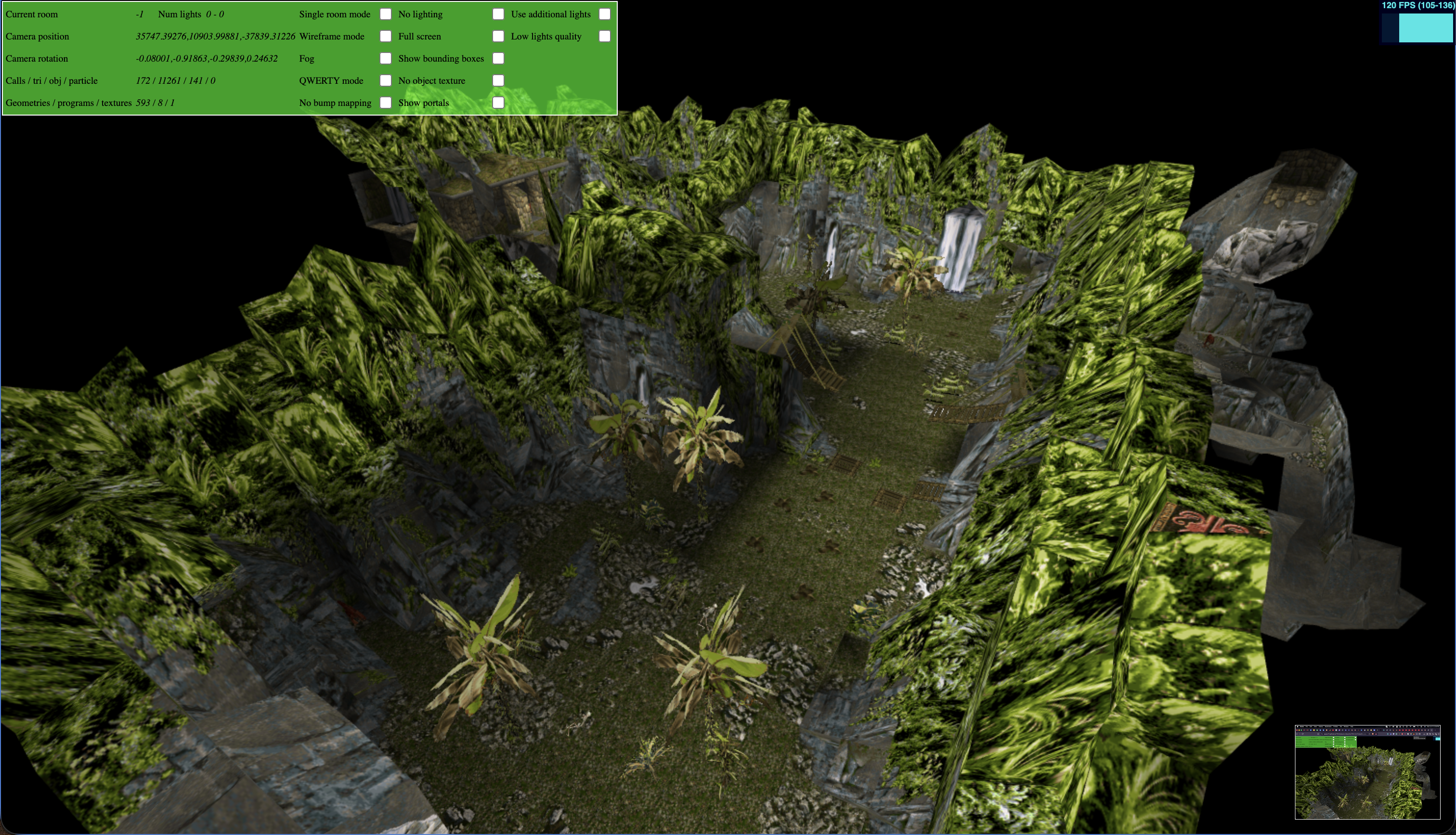
After gathering all angles, screenshots, and tech specs, I started questioning if a straight-up reverse-engineering project would really feel satisfying from a creative point of view.
The Twist
You have to understand that, as a creative, I feel an inherent urge to put my own twist on really any concept. Blame me, but I literally can't help myself. So naturally, I started questioning the original idea again, all while beginning to experiment with one texture rebuild from Tomb Raider I. But even during the process, I realized that making textures "just" high-fidelity (as modern software does) feels too "flat."
As a response, I decided to downscale it to 128x128 px; it felt limiting, even though retro games have seen a recent comeback. I believe that comeback is probably in fashion because people like me are now adults and have the same strange sensation of a little bit of healing nostalgia.

That is when I stopped for a minute and thought to myself that game devs didn't build games low-res because they wanted to, but because that was the constraint of that time. If they could have built it in 4 K, they would definitely have done it. Paul Douglas, lead programmer and co-creator of the first Tomb Raider, confirms my original assumption. In an archived Q&A session on the original Core Design website, he said:
"It would have been nice to have more powerful hardware, but the constraints of the medium shaped the creative solutions."
After contemplating the interview and the facts at hand, I discovered my twist, or at least one of them. I used my high-fidelity texture and applied a set of nodes (we will dig deeper into that in Part 4 of the series) that helped me pixelate it at full 4k resolution:
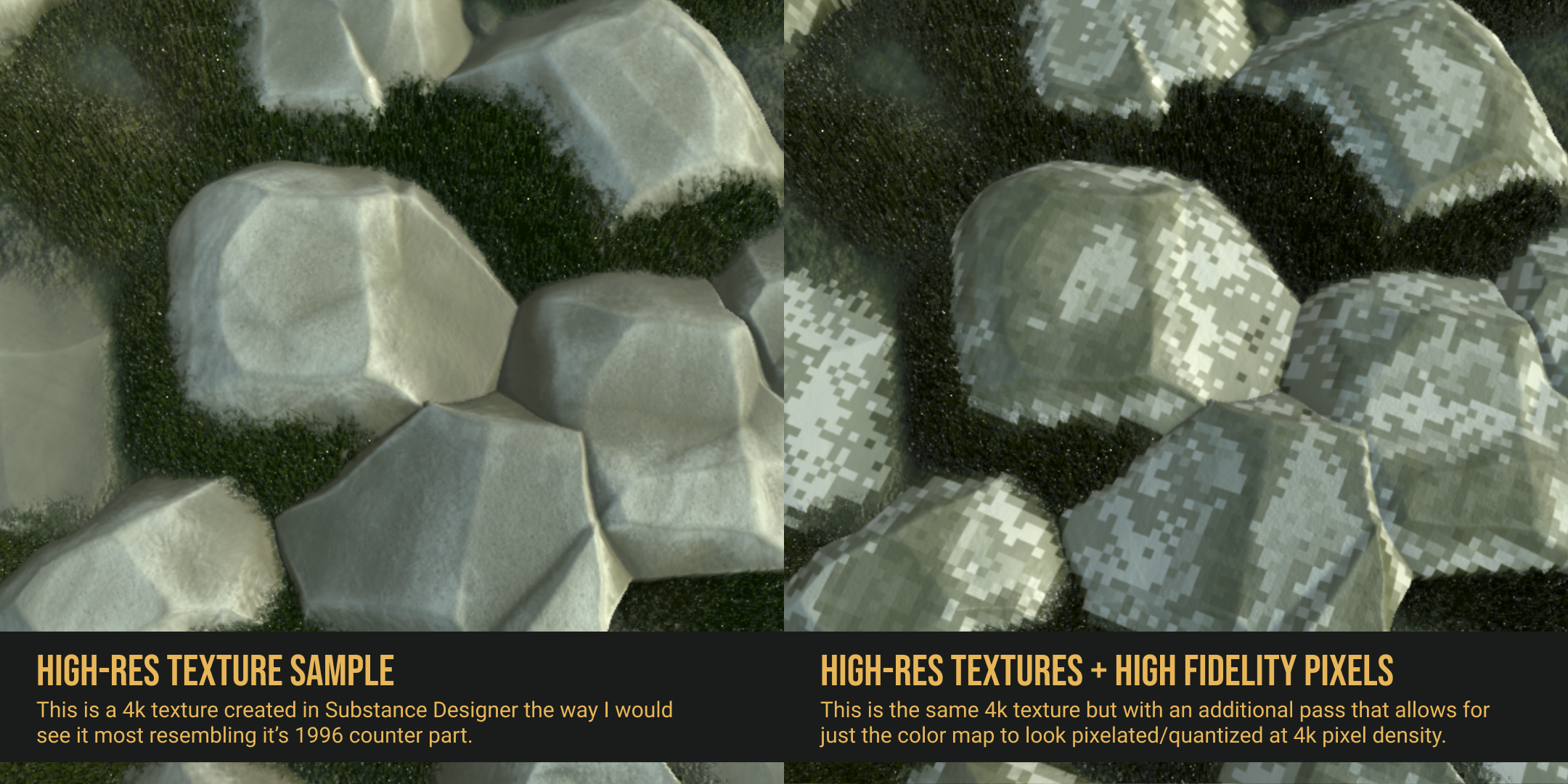
I loved it instantly. It felt like merging the past with the present. And just like that, I had my overall concept for this series. Instead of "just" reverse-engineering an already existing game, I will bring the past into the future without losing its original charms.
The Dig
Doing investigative research on an old game is not as easy as you'd think. I don't have the CD-ROM from the 90s anymore. Heck, I don't even have the drive to insert those anymore. But most importantly, the pages that hold the true gems are often buried under more SEO optimized pages. In the end, though, I worried for absolutely no reason. I discovered everything I needed on the net and on dedicated pages put together by fellow fans of the game and, I believe, the overall genre.
Some of my favorite resources were the following, for those of you who may be interested in starting a similar project:
GitHub Repository by Andrew Sychra
Contains levels from Tomb Raider 1-5 and their complete datasets.Tomb Raider Rosetta Stone
This archive is a Rosetta Stone for "reading" the file formats and tech specs of the Tomb Raider games.TRN2 a Tomb Raider Level Viewer
This one, I mentioned above, truly stood out to me because it let me review the level I selected in the browser from any angle. A true gem!The Models Resource
I was able to extract Lara from the original PHD files, but this was my backup, and it contains many more models of game nostalgia.

The main research I conducted focused on the level portion using the TRN2 tool and on extracting existing models from the original PHD files, such as "blocky" Lara, the T-Rex, and little red raptors. I also used AI to extract single texture tiles and maps so I can use them for more or less accurate coloring on my high-fidelity textures.
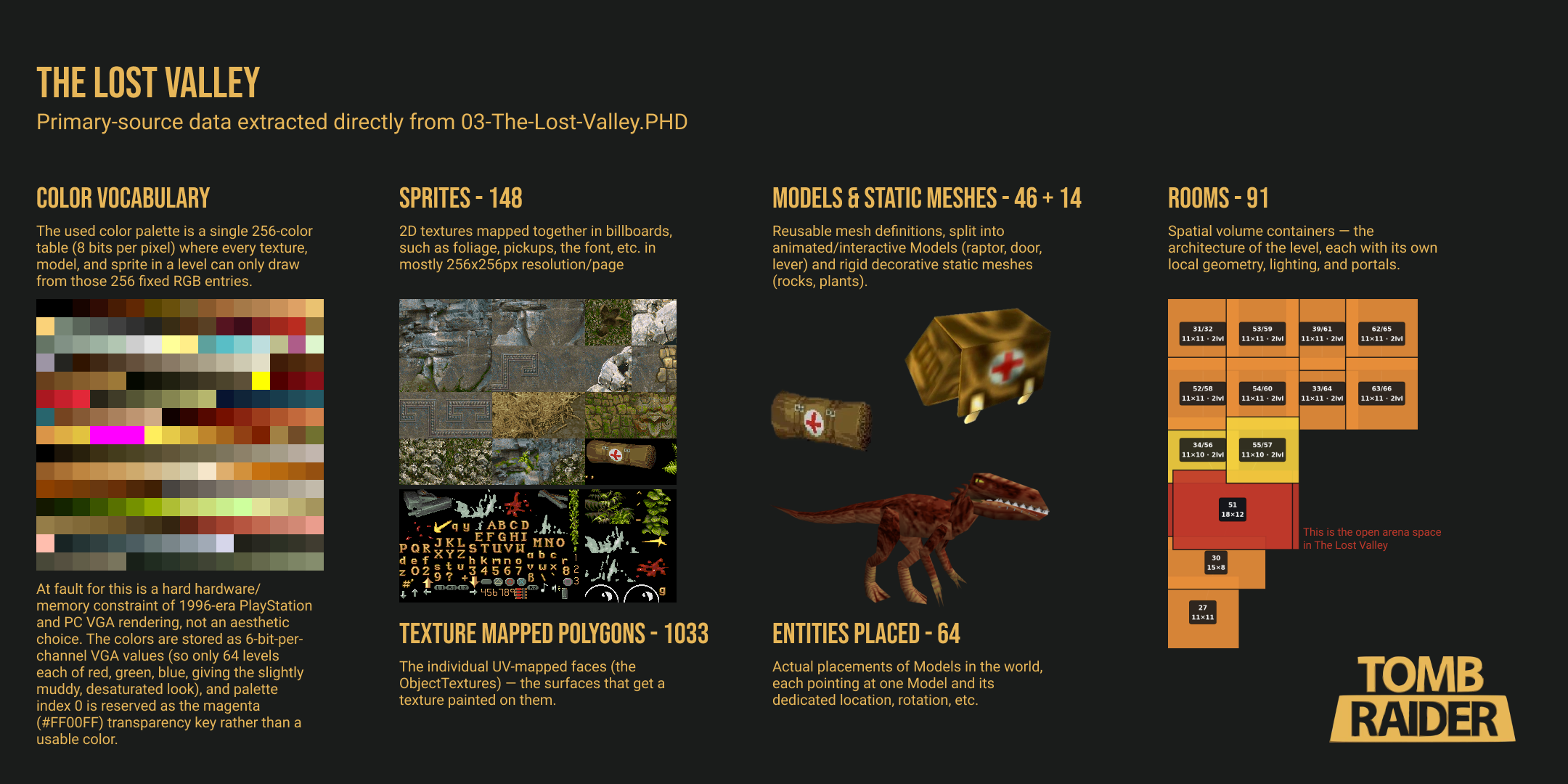
Additionally, I reviewed the tech specs in case I need to know specific details. For example, can you imagine they used only 256 colors shared across the entire Tomb Raider Lost Valley level? I feel today this is quite unimaginable, where an image taken with your iphone has more pixel density and, of course, colors than an entire game level?
Here are some of the more fascinating details I found out:
The Surprise Dig
After finishing my initial research on the game itself, I realized some narrative elements I hadn't really paid much attention to before. I always knew that the story of the first Tomb Raider (and all following) was complete fiction, but I had wondered for a while what it was truly inspired by. Due to my investigations for this project, I found out:
"The idea for Tomb Raider came from a variety of sources, both games and films, mainly the Ultima Underworld series, Prince of Persia, Virtua Fighter, Indiana Jones (of course) and all John Woo films."
Originally, Toby Gard, the main artist behind Lara Croft, came up with her story. The focus was clearly on an adventurer who was exploring tombs. But a lot changed when they decided to bring in Vicky Arnorld. She came in quite late in 1995 as a scriptwriter and was the person who turned the game into the experience it became. She wrote all dialogues, Lara's actual biography, and in his own words, Toby said at one point:
"The plot of the game was co-written with our in-house script writer Vicky Arnold."
None of this might be much of a surprise to some, but there are also some real-world relations that are inconsistent. For example, Vilcabamba is real; the original Incan stronghold lies near the city of Cusco, but it has never seen snow, as shown in the cutscene right before the Peru levels start. There is no actual "Tomb of Qualopec" in Peru, but the name itself makes sense to have been derived from the Quechuan languages. What gives it away is the phonetic sound of "-pec" or "-pak," which appears to be common in Andean names and titles (e.g., Manco Cápac, Atahualpa).

All of these probably intentional inconsistencies in the game made me wonder if it could be time to revise some of them in my project context. Given today's stance on ethnographic and cultural knowledge and respect, it felt right to me to question this aspect. Therefore, I dug even deeper, specifically on gods and kings from Incan culture that could have been connected to the sea, since Qualopec is framed as one of the ruling kings of Atlantis in the game. What came up was a sea goddess called Mama Cocha. In my efforts to discover any depictions or iconographic context of the goddess, I came out empty-handed.
So I did the best thing anyone in my position could do and reached out to the true experts here in Peru. Lima has many amazing museums and private collections. One of them is Museo Larco, a privately owned museum, showcasing over 5,000 years of Peruvian pre-Columbian history in a variety of carefully excavated and exhibited artifacts. I figured if anyone could help me find depictions, it would be them. To achieve my goal, I reached out to the current curator of Museo Larco, Julio Rucabado. Amazingly, he took the time to reply:

To summarize, he replied that Museo Larco has no visual references for the Inca sea goddess Mama Cocha, since the Incas left few figurative representations (mostly animals and a small number of male/female anthropomorphic figures), none of which anyone has interpreted as her. He adds that written sources don't describe her precisely either, so any iconographic identification is difficult.

Rucabado's response opened my eyes to a new fact I wasn't aware of, and I was happy he taught me something new. This means I don't really think I will shift away from the fictional narrative after all, but I loved visiting this alternative angle.
Sometimes creative thinking, just as science, leads you down a path that doesn't end up in success but in a new branch of knowledge. This alone makes it worth staying curious and exploratory in the truest sense of these words.
The Approach
After putting in the work of researching the section-level and technical specs in all the necessary detail, I decided to approach the rebuild in the same order as the actual article layout. First of all, it seems like a decent structure, but more so, it enables some back-and-forth flexibility for the more experimental part of the rebuild.
In Part 2, we will dive into the details of mapping out the section space in Blender using high-fidelity assets rather than simple blocks. I am excited about the challenge and a bit scared, but I guess that is a natural feeling when attempting to mess with something I have admired for most of my life.
Stay tuned for my next article and, of course, Part 2 of this new series! If you know anyone who enjoys this type of content as much as we do, send them my blog.
See you in my next piece 🙂
Support Me 
If you enjoy my writing, please consider supporting me. There are several ways of doing so, and not all of them cost money: